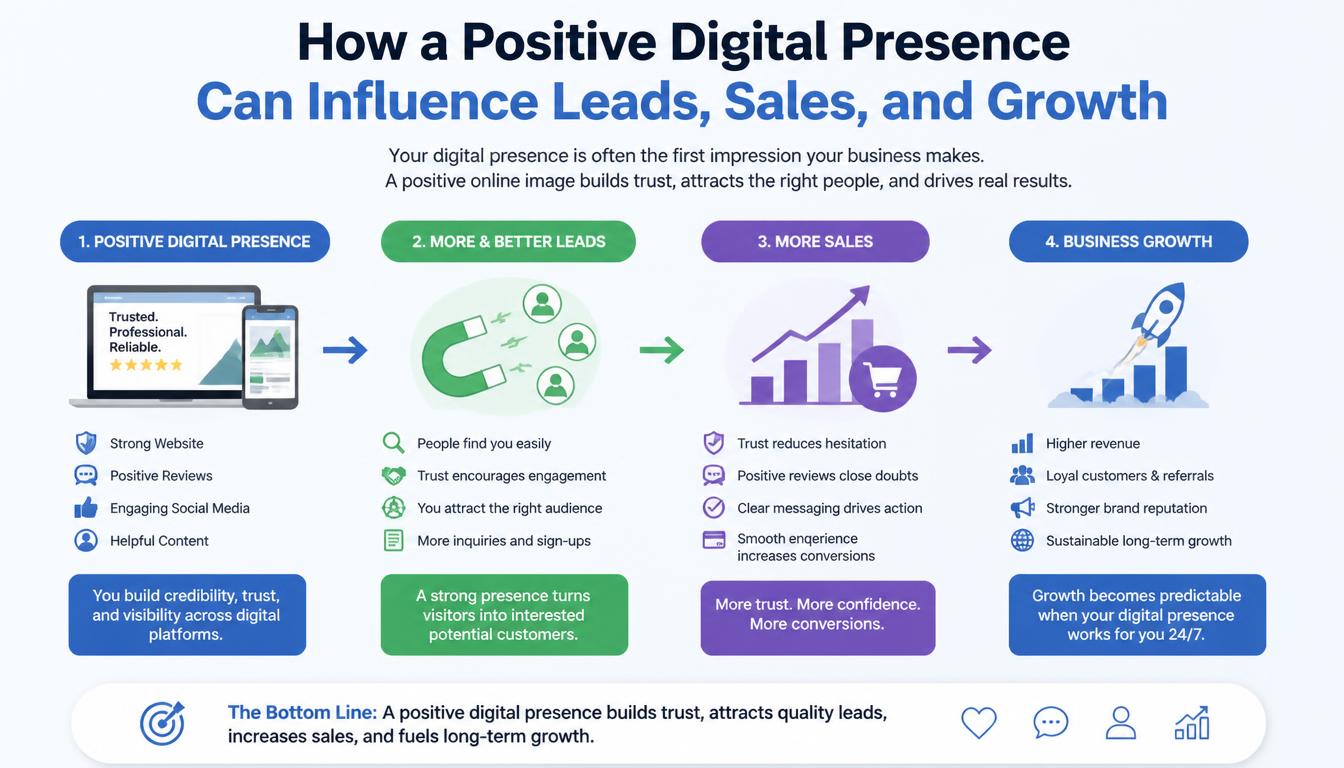
In today’s digital-first marketplace, your business is often judged before a customer ever speaks to you. A potential buyer may discover your company through Google, social media, online reviews, business directories, or industry websites. Within minutes—or even seconds—they can form an opinion about your credibility, professionalism, and value.
This makes your digital presence far more than a collection of web pages and social profiles. It is an extension of your brand identity.
A positive digital presence can help businesses attract qualified leads, build customer confidence, increase conversions, strengthen loyalty, and create sustainable growth. On the other hand, outdated information, negative reviews, inconsistent branding, or poor search visibility can make potential customers hesitate—even when the underlying business offers excellent products or services.
So, how exactly does a positive digital presence influence leads, sales, and long-term business growth? Let’s explore the key ways it can make a measurable difference.
What Is a Positive Digital Presence?
A digital presence includes virtually everything people can find about your business online. This may include your website, search engine results, social media accounts, customer reviews, business listings, news mentions, blog content, videos, and third-party profiles.
A positive digital presence means these touchpoints collectively communicate a trustworthy, consistent, and professional image.
It does not mean eliminating every negative comment or attempting to create an unrealistically perfect image. Instead, it involves actively building credibility, providing useful information, responding appropriately to feedback, and ensuring that customers encounter accurate and valuable content when researching your business. Professional ORM Services can support this process by monitoring your online reputation, addressing reputation-related challenges, and helping businesses maintain a credible and trustworthy digital presence across relevant online channels.
Think of your digital presence as your business’s online first impression. When managed effectively, it can become one of your strongest marketing and sales assets.
1. It Helps Potential Customers Discover Your Business
Before customers become leads, they need to find you.
Search engines have become one of the primary starting points for product research, service comparisons, and purchasing decisions. If your business has strong online visibility, potential customers are more likely to encounter your brand when they are actively searching for solutions.
A well-optimized website, useful content, accurate business information, positive reviews, and active digital channels can all contribute to greater visibility.
For example, imagine someone searching for a local accounting firm. They may compare several companies based on search results, websites, reviews, services, and customer experiences. A company with a complete online presence immediately has an advantage over one with little information available.
Visibility creates opportunity. The more often relevant prospects encounter your business in trustworthy digital environments, the greater your chances of generating qualified leads.
2. It Builds Trust Before the First Conversation
Trust is one of the most important factors in a purchasing decision.
Customers naturally have questions before doing business with a company:
- Is this business legitimate?
- Can I trust its claims?
- Do other customers recommend it?
- Does it have experience?
- Will I receive good service?
- What happens if something goes wrong?
Your online presence can answer many of these questions before a salesperson ever gets involved.
A professional website, detailed service information, customer testimonials, helpful content, credible third-party mentions, and active social profiles can demonstrate that your company is established and trustworthy.
This is particularly important for businesses offering expensive, complex, or highly specialized services. The more risk customers perceive in a purchase, the more they may research a company before making a decision.
A strong digital presence reduces uncertainty and makes it easier for prospects to move forward.
3. Positive Reviews Can Influence Buying Decisions
Online reviews have become an important part of modern consumer research.
Before contacting a business, many customers look for feedback from people who have already purchased its products or services. Reviews provide social proof that marketing messages alone cannot fully replicate.
A collection of authentic, positive reviews can reinforce the perception that your business consistently delivers value.
However, reputation is not simply about collecting five-star ratings. How a business responds to criticism matters too.
A thoughtful response to a negative review can demonstrate accountability and professionalism. Instead of ignoring complaints, businesses can acknowledge concerns, provide clarification where appropriate, and encourage the customer to continue the conversation privately when necessary.
This shows prospective customers that the company takes feedback seriously.
The goal should not be to create a flawless-looking reputation. It should be to build a credible reputation that reflects reliability, responsiveness, and genuine customer care.
4. It Makes Lead Generation More Effective
A positive digital presence can support lead generation at multiple stages of the customer journey.
Someone might first encounter your company through a blog post. Later, they may see your social media content. After that, they could search for reviews and visit your website. Eventually, they may submit a contact form or request a consultation.
Every digital interaction can contribute to the decision-making process.
This is why businesses should think beyond individual marketing channels. Your website, content, search presence, reviews, social media, and other online assets should work together rather than operate independently.
For example, an informative article can attract a visitor through search. A strong call to action can encourage that visitor to download a resource or request information. A professional website can then reinforce credibility and move the prospect closer to becoming a customer.
The result is a digital ecosystem that continuously supports lead generation.
5. It Can Increase Conversion Rates
Generating traffic is valuable, but traffic alone does not create revenue.
A business can attract thousands of visitors and still struggle to generate sales if those visitors do not trust the brand.
This is where digital reputation and conversion optimization intersect.
When prospects arrive on your website after seeing positive reviews, useful content, professional branding, and credible information elsewhere online, they may already have a degree of confidence in your company.
That confidence can make conversion actions feel less risky.
Depending on the business, a conversion might mean:
- Filling out a contact form
- Booking a consultation
- Requesting a quote
- Calling the business
- Signing up for a newsletter
- Starting a free trial
- Purchasing a product
- Visiting a physical location
A positive digital presence helps remove friction between initial interest and meaningful action.
6. It Differentiates Your Business From Competitors
Many industries are crowded with companies offering similar products and services.
When prices and features appear comparable, reputation can become a major differentiator.
Imagine two companies offering similar services at comparable prices. One has an outdated website, minimal online information, inconsistent branding, and several unresolved customer complaints. The other has a professional website, helpful educational resources, strong customer feedback, active communication, and clear service information.
Even if both businesses provide excellent services, the second company may appear less risky to a potential customer.
A strong digital presence gives businesses an opportunity to communicate what makes them different.
Your expertise, customer service philosophy, values, experience, case studies, and approach can all become part of your online identity.
7. It Supports Better Customer Relationships
Digital reputation is not only about attracting new customers.
It also affects relationships with existing customers.
Businesses can use digital channels to answer questions, share useful information, announce updates, address concerns, and remain connected with their audiences.
Consistent communication helps customers feel that a business is accessible and responsive.
This can contribute to stronger relationships and increased customer loyalty.
A satisfied customer may also become an advocate for your brand. They might leave a review, recommend your services to someone else, share your content, or return for another purchase.
In this way, a positive digital experience can create a cycle:
Good experience → positive feedback → stronger reputation → greater trust → more customers.
8. It Strengthens Brand Authority
Customers are increasingly looking for evidence that a company understands its industry.
Publishing useful, accurate, and relevant content can help establish authority.
A business that regularly shares educational articles, insights, guides, case studies, videos, or answers to common questions can demonstrate expertise before a prospect ever becomes a customer.
For example, a cybersecurity company could publish practical guidance on protecting business data. A financial firm could explain common investment concepts. A software company could create tutorials that help customers solve everyday problems.
This type of content does more than attract search traffic. It gives prospects a reason to trust the knowledge behind the brand.
Authority is especially powerful for businesses where customers need professional expertise before making a purchase.
9. It Helps Protect the Brand During a Crisis
Every business faces the possibility of negative publicity, dissatisfied customers, misunderstandings, or unexpected incidents.
When a company has already built a strong digital presence, it has established channels through which it can communicate with its audience.
A business with an active website, social profiles, customer communication channels, and a history of useful content is better positioned to provide accurate information when questions arise.
This does not mean positive content can make negative events disappear. Rather, a strong reputation provides a foundation of credibility that can help businesses communicate more effectively during challenging situations.
Proactive reputation management is therefore often more valuable than waiting until a crisis occurs.
10. It Can Improve Customer Retention
Growth is not only about acquiring new customers. Retaining existing customers can be equally important.
Customers who consistently encounter helpful content, responsive communication, accurate information, and professional interactions are more likely to maintain confidence in a brand.
Digital channels can also keep customers informed about new services, updates, educational resources, promotions, and company developments.
When customers continue to see value from a business after the initial transaction, the relationship can extend beyond a single purchase.
Over time, this can contribute to repeat business and stronger customer lifetime value.
11. It Creates Long-Term Marketing Value
Some marketing activities stop producing results when spending stops. A positive digital presence can continue generating value over a much longer period.
A well-written article may attract search traffic months or years after publication. A customer testimonial can continue influencing prospects. An informative video can answer questions repeatedly. A strong business profile can help customers discover your company long after it was created.
This makes digital reputation and content assets valuable long-term investments.
Of course, maintaining them requires ongoing attention. Search algorithms change, customer expectations evolve, and outdated information can quickly reduce credibility.
The goal is therefore not to build your online presence once and forget about it. It should be continuously monitored, improved, and updated.
12. It Gives Businesses Valuable Customer Insights
Your digital presence can also reveal what customers actually care about.
Website analytics can show which pages attract attention. Search data can reveal what questions prospects are asking. Reviews can highlight recurring customer concerns. Social media conversations can reveal changing preferences.
These insights can influence business decisions beyond marketing.
For instance, if customers repeatedly ask the same question in reviews or support interactions, that information could inspire a new FAQ page or educational article. If visitors consistently leave a particular webpage quickly, its content or user experience may need improvement.
In this way, digital feedback can become a source of continuous business intelligence.
How to Build a More Positive Digital Presence
Creating a strong online reputation requires consistency rather than a single campaign.
Start by auditing what customers currently see when they search for your business. Review your website, social media profiles, search results, business listings, reviews, and other prominent online mentions.
Then focus on the fundamentals:
Keep Information Accurate
Make sure your business name, contact information, services, operating details, and other important information are current and consistent.
Publish Helpful Content
Create content that answers real customer questions instead of producing articles solely for search engines.
Encourage Genuine Reviews
Ask satisfied customers to share honest feedback through appropriate review platforms. Never rely on fake or misleading reviews.
Respond Professionally
Acknowledge legitimate complaints and questions. Avoid emotional arguments or defensive responses.
Maintain Consistent Branding
Your visual identity, messaging, tone, and company information should feel consistent across major digital channels.
Monitor Your Online Reputation
Regularly check what customers and prospects are saying about your business. Early awareness makes it easier to address potential issues.
Make Your Website User-Friendly
Your website should clearly communicate who you are, what you offer, why customers should choose you, and what visitors should do next.
The Business Impact of a Strong Digital Reputation
A positive digital presence does not guarantee overnight success. Instead, its value compounds over time.
Greater visibility can lead to more website visitors. Better credibility can turn visitors into leads. Stronger trust can improve conversion rates. Positive customer experiences can generate reviews and referrals. Consistent communication can strengthen retention.
These elements reinforce one another.
Consider the broader customer journey:
Discovery → Research → Trust → Contact → Conversion → Experience → Review → Referral
Your digital presence can influence almost every stage of this journey.
That is why reputation should not be treated as a separate activity that belongs only to the marketing department. It can influence sales, customer service, business development, recruitment, partnerships, and overall brand perception.
Final Thoughts
In a competitive digital marketplace, customers have more information—and more choices—than ever before. Before they purchase, they can research your company, compare competitors, read reviews, examine your content, and evaluate your credibility.
A positive digital presence helps ensure that this research works in your favor.
It can attract qualified prospects, establish trust, support lead generation, improve conversions, strengthen customer relationships, differentiate your brand, and contribute to sustainable growth.
The most successful approach is not to chase perfection. It is to build an authentic, consistent, useful, and trustworthy online identity.
When customers repeatedly encounter valuable information, positive experiences, credible feedback, and professional communication, your business becomes easier to trust.
And in a marketplace where trust often determines who gets the click, the inquiry, and ultimately the sale, a strong digital presence is no longer optional—it is a fundamental part of building a successful brand.